Friday, 9 January 2015

Alcohol - Is it Killing YOU?

Pertinent after the usual alcohol indulgence of Christmas.............

Alcohol poisoning kills six people a day in the USA - about 2200 a year.

By that data, Australia with a population of about 24 million compared to the 317 million in the USA, our toll is around 3 per week or 140 per year.  But I suspect it might be more as we Australians probably drink more than many in the USA.

Some recent stats are quite alarming, and strongly support much higher alcohol poisoning events in Australia.

Alcohol consumption accounted for 3.3 per cent of the total burden of disease and injury in Australia in 2003; 4.9 per cent in males and 1.6 per cent in females.

In Australia:
  • Alcohol is second only to tobacco as a preventable cause of drug-related death and hospitalisation
    • between 1992 and 2001, more than 31,000 deaths were attributed to risky or high-risk alcohol consumption [ say 3100 per year]
    • in the eight years between 1993–94 and 2000–01, over half a million completed hospital episodes were associated with alcohol
  • While the number of emergency department presentations caused by alcohol is unknown, it is likely to account for a large proportion of all presentations
  • Alcohol accounts for 13 per cent of all deaths among 14–17-year-old Australians — it has been estimated that one Australian teenager dies and more than 60 are hospitalised each week from alcohol-related causes
  • Alcohol is also a significant contributor to premature death and hospitalisation among older Australians — among 65-74-year-olds, almost 600 die every year from injury and disease caused by drinking above the NHMRC 2001 guideline levels, and a further 6,500 are hospitalised.
  • Although most surveys show that Aboriginal and Torres Strait Islander people are less likely than the general population to drink, alcohol attributable injury and disease are particularly high among this group.
  • The rate of alcohol-attributable death among Indigenous Australians is about twice that for the non-Indigenous population, with a particularly strong association apparent between alcohol use and suicide among some Aboriginal and Torres Strait Islander people.
Enough to put the frighteners on???

Also remember the campaign to have a dry or alcohol free January!

Thursday, 8 January 2015

Support Free Speech

What a dreadful event yesterday in Paris.  Awful.

It is akin to someone shooting the much loved cartoonist here in Darwin - Colin Wicking - who is well renowned for his irreverent Christian cartoons, often around Easter time.

While definitely seen by some as anti-Christian, they are I think an opportunity taken to take the mickey out of people.

You do not have to agree with the sentiments but please respect the option of free speech, especially in a pluralist, secular society.

Satire is wit, cutting yes..... but wit.

The world has responded with many more cartoons, mostly supporting free speech, and quite a lot very much to the point.  I have not seen too many outright anti-muslim.

France certainly has a strong minority that is muslim and might feel hurt over the cartoons but surely this is over the top.

There are some excellent cartoons here - 

http://www.abc.net.au/news/2015-01-08/jesuis-charlie-social-media-reacts-to-charlie-hebdo-shooting/6005672

and I particularly like this one by David Pope.
[cartoon used with acknowledgement]

Embedded image permalink

Cane Toads and Fungi on the Move - Early 2015

Just over the past week with the start of monsoon rain has seen our local cane toad population start moving.

My judgement is based on numbers seen on the nightly dog walk and where they are.
The dreaded cane toad
It must be said first - NEVER seen one on Trower Road or along the cycle path along Rapid Creek - EVER,  until this week, although the odd one on Waters Street and Oliver Street and other paved areas up from Rapid Creek.

First - several seen [ with one kill] on Trower Road around Rapid Creek / Jingili and surprisingly the first ones seen ever on the seaward side of Trower Road.  One went under a car - good riddance - but two others will go on to do more harm unfortunately, as I did not have a suitable weapon to despatch them to the great toadhole in the sky.

Last night, after a light rainfall day, resulted in one toad - about 18 -20cm - found on Oliver Street in Rapid Creek, sitting up under a light post.   Believe I despatched that one, and the remnants went down the drain under the road.  They are very resilient blighters though, so not absolutely sure it was despatched permanently.

So to anyone reading this around Rapid Creek - watch and act..............despatch the dreaded cane toad to the nether regions by whatever means needed.

Monsoon rain also brings a lot of toadstools and mushrooms, especially now with so many council areas /households using mulch. A more pleasant outcome.

Fungi love the damp monsoon conditions


Wednesday, 7 January 2015

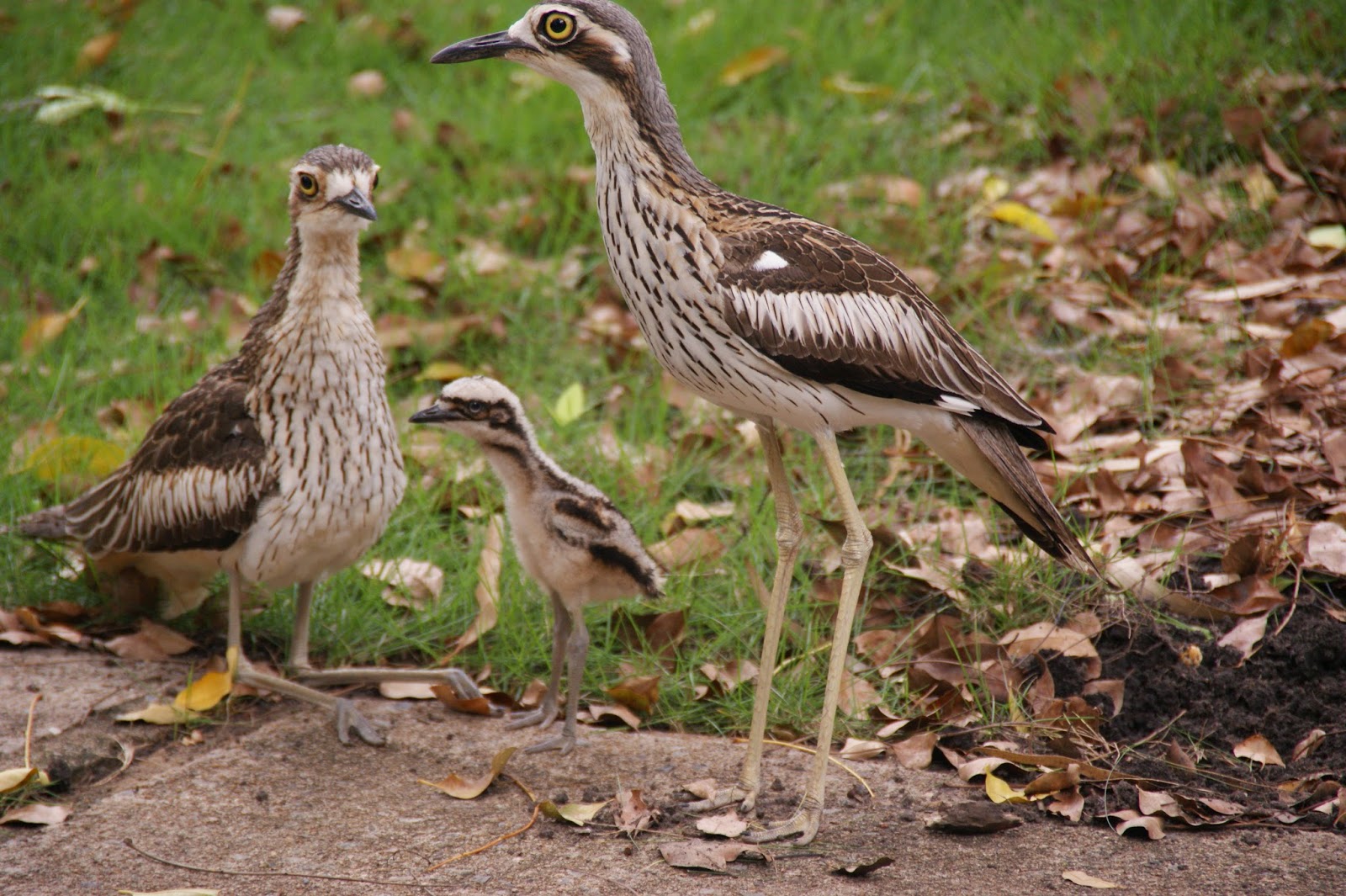
Curlews and Chick

Found...........a breeding pair of curlews and chick - in our driveway.

Very cute, and they hung around for several hours, through a couple of rain showers, with the chick decidedly not an active flyer!

Was some curlew noises in our large mahogany tree over the past week or so.......might be resident there.

Enjoy the photos.  Was able to get within about 5-8m and the long lens was filled!

That is a real bonus.


Curlew breeding pair and chick
 All photos copyright - please seek permission before use.

Tuesday, 18 November 2014

Renewal

Rain in the monsoonal tropics brings renewal.

And..........when the large gum [ eucalypt] trees get like this.......then rain is coming.  glorious renewal.

Trouble is, this build up season is so hot, and so little rain, so little - like none - cloud cover yet.

But the trees are saying......renewal is coming!

Rain is coming...........maybe soon?

Wednesday, 22 October 2014

Lizards in the Garden

Seen yesterday and had to get a photograph- a tata lizard laying eggs.

I missed a photo of the actual egg laying as I raced to get the camera, but did actually see that as well.

Anyway............ two eggs to display.

This time of year the ta ta lizard - called because it holds up a hand as if waving good bye, is common around suburban yards in Darwin and much of the Top End.

Yes, it is not unusual to see eggs that have been deposited in shallow hole in the ground.......but rare to catch them in the act!

Enjoy!

Ta ta lizard laying eggs
 More details here -http://en.wikipedia.org/wiki/Lophognathus 

Friday, 9 May 2014

Ukraine, Putin and History

Putin's power play straight from the pages of history


Putin's foray into Ukraine is following the same path and pretext as Catherine the Great's did in the 1700s. And just as the empress had international allies, Russia is now pressing Germany to legitimise its manoeuvring, writes Matthew Dal Santo.

History, they say, never repeats itself. But events in Ukraine bear an uncanny resemblance to the Partition of Poland more than 200 years ago.

Careful attention to how it unfolded can help us see where the power to bring an end to the crisis lies today - and it isn't in Washington.

Though it has gone little commented upon, German chancellor Angela Merkel has spoken frequently with Russian president Vladimir Putin over the past week. Their most interesting conversation took place last Thursday.

For Mrs Merkel, the immediate issue was the release of a group of Organization for Security and Cooperation in Europe observers held by pro-Russian forces in Slovyansk. For Mr Putin, however, it was geopolitics.

According to the Kremlin, the Russian president urged Mrs Merkel to use her influence over Ukraine's interim government to prevail on Kiev to withdraw its forces from southern and eastern Ukraine.

Precisely how the German chancellor reacted isn't known. But Mr Putin was, in effect, asking her to consent to a partitioning of Ukraine between the pro-Western, and Western-backed, government in Kiev that is in favour of closer ties with NATO and the EU, and pro-federalist or separatist militias backed by Russia in the east and south.

Outspoken in her criticism of the Kremlin's tactics in Crimea, Mrs Merkel has since become more circumspect, as if unwilling to push her dealings with Putin into a rhetorical corner. She seems personally disposed to take a harder line with the Kremlin, but the pressure on her from German businesses and a surprisingly pro-Russian political establishment - on both the left and right - has been enormous.

It's been estimated that 300,000 German jobs depend on exports to Russia. At the same time, as the EU's unofficial gatekeeper, Mrs Merkel is among the few Western leaders who could persuade Kiev to agree to the federalisation plan Moscow insists is essential to quelling the violence.

By far the European leader with the most influence in eastern Europe, she finds herself in an awkward position - one a long line of German leaders has been in before. She has geography, the Kremlin and Germany's own strength to thank for this.

Germany is the only European country Putin - himself fluent in German - takes seriously. It's also one of Russia's biggest trading partners.

In 2013, Russia exported some €40 billion in trade with Germany, mostly oil and gas, the bread and butter of the Russian economy.
T
hough Germany would inflict real harm on itself, a tough sanctions regime would apply real pressure on Russia. The two countries have a long history of dividing up their neighbourhood. In 1939, the Molotov-Ribbentrop Pact between Hitler's Germany and Stalin's USSR put an end to an independent Poland. In 1918, the Treaty of Brest-Litovsk divided all the lands of modern Poland and Ukraine between the Kaiser and the Bolsheviks - generously in Germany's favour.


But the most instructive division of Europe from today's perspective took place when Russia's Catherine the Great, Empress of Russia from 1762 to 1796, partitioned the sprawling Polish Commonwealth between herself and Europe's two leading Germanic powers: Frederick the Great's Prussia and Maria-Theresa's Austria.

Eighteenth-century Poland - then Europe's largest country save Russia itself - included much of the lands that now lie in today's Ukraine.

Indeed, Putin is today pursuing more or less the same strategic aims as Catherine the Great, when she first brought Russian rule to Europe's southern steppes in the 1760s, and doing so in much the same way and on much the same pretext.

Fabled for its ancient constitution that provided for a king elected by parliament (the Sejm), enshrined the right of even a single nobleman to veto royal legislation and licensed rebellion of noble factions against the crown, Poland was in fact an anarchic place dominated by local magnates with their own private armies, which they used to extract revenues from the peasantry in their domains.

It was a situation external powers found irresistible, not least Catherine's Russia. In other words, 18th-century Poland was not at all unlike modern Ukraine, where in 20 years of independence regional oligarchs have used their power and money to gouge out local monopolies at the expense of the overwhelming majority of the country's citizens, and which until late last year the Kremlin found easy to exploit as it played one elite client off against the next.

It's a strategy Putin might have taken straight out of the 18th century empress's playbook. In 1764, Catherine took advantage of Poland's divisions to install a former lover on the Polish throne.
As king, however, Stanislaw turned out to be made of stronger stuff than expected. Rather than merely toeing Catherine's line, he set out to reform the Polish state, curtailing the nobles' veto rights - rights, as Catherine well knew, that had made Poland ungovernable and so easily amenable to foreign (i.e. Russian) influence.

Styling herself the defender of Poland's "ancient freedoms", in 1768 Catherine used the threat of invasion to force Poland's King Stanislaw to sign a treaty not only to protect Poland's Orthodox minority - whose religious freedoms she claimed Stanislaw's new constitution threatened to undermine, much as Putin has lately been doing on behalf of Ukraine's sizeable Russian-speaking minority - but also to restore the unwieldy constitution Stanislaw had sought to modernise.

Agreeing to this treaty was a trap that allowed a faction of nobles to cast Stanislaw as a Russian puppet. And when they revolted - as fed up Ukrainians did last year when another ruler gave up a potentially transformative trade agreement with the EU - Catherine pounced. In 1771, under the guise of protecting law and order, a Russian army entered Poland.

The country collapsed. The Ottoman Turks declared war, but the Russians defeated them and made them hand over Crimea. Unwilling to fight or go to war, Prussia and Austria instead decided to join Catherine in dividing Poland up.

The result, in 1772, is what has since become known as the First Partition of Poland, which awarded thousands of square miles of Polish territory to Russia, Austria and Prussia.

In 1783 Catherine annexed Crimea and pushed the Ottomans south towards the Danube. Into this so-called New Russia, Russian settlers followed, whose "rights" Putin has lately deployed the Russian army to defend. It took two further partitions to erase Poland from the map.


They have since become a byword for double-dealing, as diplomats in hushed drawing rooms disposed of a fractious, aristocratic commonwealth that 19th century liberals loved to present as a tragic tale of democracy denied.

Behind the recent crisis lies a combination of elite infighting, constitutional wrangling and Russian opportunism at Europe's eastern crossroads that's almost a set-piece replay of the situation Catherine exploited.

Like Catherine, Putin took advantage of squabbling between Ukraine's modern-day elites for a division of the country's spoils. And just as Catherine's treaty trapped Stanislaw, so too the Kremlin's deal-making with then Ukraine president Viktor Yanukovych delivered him into Putin's pocket, including the $15 billion loan for walking away from the EU's trade deal that ended up making him look like a Russian stooge.

Ever since, Putin has been playing the same legitimist card as Catherine, presenting Russia as the defender not only of the lawful Ukrainian president and legitimate Ukrainian constitution, but also of the "rights" of Ukraine's Russian speakers, first in Crimea, now in Donbas and Odessa.
What Catherine had but Putin has always lacked are international partners to legitimise the sphere of influence he has asserted and, to all intents and purposes, carved out.

Led by the United States, the West won't talk, but like Prussia and Austria in the 1770s, however, it has ruled out war to make him give them up.

This is where Germany's Angela Merkel comes in. Like Frederick the Great and Maria-Theresa in the 1770s and 1790s, she was last Thursday being asked to partition Eastern Europe with Russia.
She can be forgiven for being surprised at finding herself in this position. The "end of history" - the fall of the Berlin Wall, the expansion of the EU and NATO - was supposed to put a stop to this sort of thing.

What it hasn't changed, however, is Germany's position as the richest and most powerful country at the centre of Europe. Not only is Germany the only big European country Russia will deal with, it's the only one that really has to.

The other thing that hasn't changed is Russia's view of its interests. As in the days of Catherine the Great, Russian meddling has again plunged a fatefully divided neighbour into a constitutional crisis that has allowed the Kremlin to intervene as the defender of law, order, and minority rights.


Now as then Moscow is looking for a Western partner to acknowledge its interests; Germany is the Western power with the most pressing interest in doing that. Today, of course, partition doesn't mean the actual dividing up of Ukraine between Russia and Germany.

What it does mean is that, in return for a Russian promise to let the Ukraine's western half drift closer to Europe, Mrs Merkel would apply her influence to encourage the authorities in Kiev to listen to Russia's demands for the country's federalisation, an outcome that would leave Russia's border where it is but reassure the Kremlin of its influence in the eastern and southern regions it considers essential to its security - and prevent the country as a whole moving definitively into the West's orbit.

Morally, this is an invidious position for any democratic leader to stand in. But short of a compromise along these lines, the only alternatives are sanctions (which will harm Germany almost as much as Russia, and, from Berlin's point of view, embitter an important regional partner) or war on Ukraine's behalf (which everyone has ruled out).

While Catherine, of course, seems hardly to have let such scruples bother her, it's said that Austria's Maria-Theresa sobbed guilt-ridden as she divided Poland up with Russia's wily empress. But having ruled out the unpalatable alternative, she pulled herself together. "The more she wept, the more she took," Prussia's more pragmatic Frederick the Great mocked.

Normally noted for her pragmatism rather than sentimental or ideological attachments (she shed not a tear when the bailout conditions she imposed on southern Europe cost thousands their jobs), this crisis seems thus set to test Mrs Merkel's non-committal political strategy to the limits.
By taking the moral high ground, and with so little at stake economically in Russia, Washington has made itself secondary to the only real diplomatic solution to this crisis - one that gives Russia at least some of what it wants. 

But Mrs Merkel hasn't yet fully shown her hand and, with much more on the line, we should definitely pay more attention to her phone calls with the Kremlin.

Matthew Dal Santo is a freelance writer and foreign affairs correspondent. He previously worked for the Department of Foreign Affairs and Trade. View his full profile here.
-----------------------

This first appeared on the ABC web site - the Drum.

Certainly offers a good overview of the situation and some historical context.  Too often we as Australians are unaware of the nuances involved.  Too far away, too little interest really.

A good overview and food for thought.

The comments on the article are also worth a read.

More here -

www.abc.net.au/news/2014-05-09/dal-santo-putins-power-play-straight-from-the-pages-of-history/5440894



Tuesday, 29 April 2014

Amazing Inventions that could Save Your ife


Every year medical researchers are discovering new technologies to save lives and increase life expectancies. Here’s 10 of the most exciting medical marvels.
New medical breakthroughs are improving the quality of life. Photo: Shutterstock

Seventy-five years after Australian pharmacologist Howard Florey began his pioneering work with penicillin, Australians have continued to live longer and healthier lives thanks to medical breakthroughs.
Professor Bob Williamson, from the Australian Academy of Science, says the steady discovery of new drugs and devices has drastically improved our way of life.
“Many of us who are now reaching retirement age remember when we were children the single most dreaded disease of all was polio,” he says.

“Polio now no longer exists, even measles which was a very serious disease just 25 to 30 years ago, has been virtually eliminated by immunisation.
“Nowadays life expectancy keeps going up.”

The average Australian male life expectancy is 79 and 84 for women, according to 2013 Australian Bureau of Statistics data. Experts predict life expectancy figures will continue to grow and death rates fall, thanks in large part to groundbreaking medical advances.
Here, The New Daily highlights 10 medical marvels improving the quality of life.

1. 3D printing

Currently used to print customised medical devices such as splints. Successfully used to save six-month-old Kaiba Gionfriddo’s life in May last year after doctors found he had tracheobronchomalacia, a condition that caused his airways to close and his face to turn blue.
Doctors hope 3D printing will be used to print new body parts.
Long-term, doctors hope this technology will be used to print new body parts such as human muscle, bones, nerves and cartilage. ‘Bioprinting’, as it is known, will use donor stem cells to print human tissue and has the potential to spare patients from long waits for organ donation.

2. The bionic eye

Australian researchers are at the forefront of bionic vision innovation. The bionic eye has the potential to return sight to blind and visually impaired people. The technology works by stimulating the perception of light, but has to be tailored to suit each patient.
Three patients have already been implanted with the bionic eye and have reported seeing objects on a screen after the device’s camera was connected to a stimulator.

3. Ex-vivo heart resuscitation

Research by experts at the Victor Chang Cardiac Research Institute shows seemingly dead human hearts can be brought back to life. Using donor blood and a specialised machine, donor hearts can start beating again up to 30 minutes after death.
Doctors had previously ruled out heart donations from patients who had suffered cardiac death. But this new development could dramatically increase the number of hearts available for transplant.

4. Cheaper genome sequencing

Australians will soon be able to use machines that sequence a whole human genome for as little as $1000. The same process cost more than $1 billion a decade ago.
 
Mapping a whole human genome may cost as little as $1000.
New machines are capable of sequencing about six billion base pairs in a person’s DNA – the key to unlocking mystery genetic illnesses. This will also help doctors tailor more targeted treatments to a patient’s genetic data.

5. Wearable kidneys

Battery-powered artificial kidneys could mean a whole new way of life for people on dialysis. Wearable kidneys are similar to mini-dialysis machines that can be worn like a belt. Human trials have started in the US and kidney experts are hopeful it will be commercialised in five years.

6. Electronic skin

Israeli researchers are developing flexible nanotechnology sensors to integrate into synthetic skin to return the sensations of touch, humidity and temperature to amputees. The electronic skin, or e-skin, would attach to prosthetic limbs and detect multiple sets of data that allow patients to experience simultaneous sensations.

7. Epilepsy implant

Brain implants that detect oncoming seizures could save the lives of thousands of epilepsy patients. The neurostimulator, which has recently been approved for use in the US, reduces life-threatening seizures. Sensors in the implant detect approaching seizures by reading brain activity and sending electrical pulses to switch off faulty signals.

8. HIV and Hepatitis C drug

Australian company Biotron is finding exciting results from clinical trials into an anti-viral drug for patients infected with HIV and Hepatitis C. Latest results released last month show patients were virus-free after six months of treatment with the drug, BIT225. Depending on further trial results, this drug could be a game-changer for more than 24,000 Australians battling HIV and almost 227,000 diagnosed with chronic Hepatitis C.

9. Low radiation CT scanners

These new scanners delivers high definition images without the high levels of radiation found in current CT scanners.
New scanners deliver high definition images without  high radiation.
New scanners deliver high definition images without high radiation.
This means radiation is reduced by up to 50 per cent throughout the patient’s body.

10. GPS-based devices

To accurately navigate the site of surgery, doctors are using GPS-based guidance equipment. The robotic systems define the exact location of entry points for patients undergoing spinal and orthopaedic surgery, eliminating the need for multiple X-rays used in traditional surgery techniques.

Wednesday, 23 April 2014

Birthday Cheer


Some decent birthday champagne...........and it was good!!

Tuesday, 31 December 2013

Christmas Monsoon for Frogs

The season of giving and receiving.

Monsoons that is........with a strong NE monsoon in peninsula Malaysia and Singapore, as well as in East Malaysia there is some trepidation about heavy rain and possible floods in some areas.

In Singapore it has made for great weather with a strong breeze and overcast conditions - really great for walking around, with just a few decent showers and storms.

Malaysia is expecting more rain and floods on the east coast, and there has been some flooding in parts of Sarawak.

North Australia did not miss out either, with  a monsoonal burst across the north including a severe to major category 3 cyclone which crossed the coast of WA near Wickham, and is now moving S and SE bringing wind and more rain.  Not too much damage though.  Plenty of images on line.

While the heavy rain is a bit unpleasant, it is the lifeblood of the country, especially across north Australia, refilling creeks and waterholes and sustaining life. 

I am sure many welcome it.  The frogs sure do!!!

Tuesday, 24 September 2013

That Time of Year - Troppo Season

There are signs, apart from the hot days and hot nights, as well as the high humidity.

These include:

ripe mangoes increasing in abundance

flowering rain trees in profligate colour and then leaving their flowers on the ground

madly flowering yellow Tabeuia argentea trees along Trower Road from Casuarina to the end

tempers shortening, more cross words

increasing use of air conditioners

increasing or even re-instated use of swimming pools and spas [ usually usage abandoned in the dry season as it is too cold for locals]

increased use of liquid refreshments - of all types

lawns growing

tourists leaving town

AND...............last but not least - green tree frogs noisely croaking in any damp place, or at any sign of rain! 


All are now occurring....................must be close to the troppo season in Darwin.

green tree frog
!

Sunday, 25 August 2013

Milk + Coffee - A Complex Conundrum

"What milk in your coffee, sir?"

Will it be ordinary, permeate free, skim, light, A2, soy, lactose free, gluten free, goat, sheep,  or will sir's coffee be plain black?

It is a complex conundrum to decide what your milk choice will be today in many coffee shops.

It is that same issue of choice where too much choice is the problem.  Hark back to the time when a cappuccino was just that and the big question of choice was cup or mug - no, not even a take away.

Is the coffee any better?

While choice of coffee blend has improved, and that itself creates more choice..............is it worth it?

I admit, I do prefer certain coffee blends  - and a current one from the Brazilian Cerrrado region is a bit of a favourite right now - and best drunk black.

Aficionados might even say - is there any other way than black to drink coffee?

 
But so many milk choices, so many!  Think of the experimental interactions within a simple [???] cappuccino.  Eleven or more milk choices by shall we say three or four available blends at mild, normal, strong or extra strong  - That is a staggering   11 milks x 4 blends  x 4 strengths = 176 options.

No wonder that barista is sometimes a bit short in the mornings!!! 

Blinded by choice - best to do your own.  If you stuff it up........too bad.


Saturday, 24 August 2013

RAIN - Dry Season Over?

The BOM predicted it - and it was just as they said.

Rain in the evening and quite a bit more the next morning.  Had 7.5mm in Rapid Creek, 8mm at Nightcliff Pool and 10 - 12mm in Northern suburbs, but only 2mm at the Darwin Airport.

Darwin had a taste of the rainy stuff during the week [ 21st], and could the dry season be over?

You would hardly think so this weekend - low humidity and a 17 and 18C overnights.  But the end of August approaches.

A notable end of August coming too - 31st anniversary I am told of the monumental album by Neil Diamond - "Hot August Night" is on  24 August 1972  - [ http://en.wikipedia.org/wiki/Hot_August_Night. ]

Monday, 19 August 2013

Changi Airport to Grow ENORMOUSLY

Singapore is planning a bit of growth at Changi Airport.

T4 is coming soon but then Terminal 5 [ T5] is basically going to double the size of the airport again.

So by 2030 there will be  third runway and it will be a whole lot bigger.

More here -
http://au.news.yahoo.com/thewest/business/a/-/world/18555440/singapore-to-double-capacity-of-changi-airport/

Sunday, 23 June 2013

Purple Flowered Vine - Fantastic

Seen on the neighbour's fence in Darwin this week - it looks magnificent. 

Purple flowers, fading to light lavender then white [last photo]. Had trouble downloading off the camera so these are after a few days in full flower [had to use a different CF card - which worked okay] but colour has lightened a little.  Was a magnificent purple initially. Also seen in Singapore, but never as a fantastic display like this.

Look online for more - Mansoa hymenaea. 

Cultivation notes:


Scientific name: Mansoa  hymenaea
Family: Bigoniaceae
Common name: Garlic vine

Habitat: Native to Mexico And Central America. It is best to grow it in well-drained soil that is mulched at the base with compost to keep the roots cool and moist. M. alliacea occurs on solid ground, not close to bodies of water, in shaded areas of low vegetation and in small primary forests. It cannot grow in flooded areas or in open fields. It occurs in tropical areas with rainfall of 1800-3500 mm/year, at temperatures between 20 and 30 ºC. Mansoa hymenaea is a native plant of Brazil and Peru (Thetburanatham, 1987), but grows very well in most the parts of Thailand (Chirunthorn et al., 2005).
Botanical Description: Dicot. Plant grow up to 9 m , has simple leave that has elliptic margins.When the leaves are crushed a garlicky smell will be given out. Flowers are trumpet-shaped and is pale and purple in colour and grows in clusters. Flowers seasonally from March to May. Requires sun and partial sun.
Propagation: Stem cutting
Medicinal Uses: The entire plant such as roots, stems and leaves have medicinal uses and are used to reduce fevers, treat colds, throat, and respiratory troubles.
Source :
http:// en.hortipedia.com/wiki/mansoa-hymenaea
http://gardeningwithwilson.com/2009/08/06/the-garlic-vine/
 

Mansoa hymenaea - used while own photos u/s


Saturday, 22 June 2013

Crazy Weather in the Tropics

Fires are creating an enormous problematic smoke haze over Singapore and Johor Bahru state in Malaysia - fires in Indonesia.

And while this seems to happen almost every year in the dry season, it has been exceptionally bad this week with the haze and smog reaching dangerous levels that can be very unhelpful to your health.

It might have cleared a bit today, but still NOT good.

The Top End is beset for over a week with overcast windy cloudy weather and a few light rain showers around the region.  None in our gauge, but certainly been rain around with falls up to 3-4mm, but most 1-2mm.  It is still very cloudy tonight, and wind has dropped, so humidity is up.

Might be a bit sunnier and clearer tomorrow, or so they say.

Cloudy weather means the solar hot water system needs an electrical boost, and with our current shortest day of the year it is currently just tepid - not good for showering!


So............cloud on both sides of the equator.  Not common at all!

UPDATE - on 26 June, HAIL recorded in Singapore.........definitely crazy.
smoke haze Singapore June 2013

 
smoke from Sumatra streaming across Singapore
 
Ours is not that bad!!! 

Wednesday, 19 June 2013

Shopping - On line or Not?

Today an op-ed piece appeared on the ABC web site.

http://www.abc.net.au/news/2013-06-17/alberici-online-shopping/4760168

It has several hundred comments, and the entire article is well worth reading.  Written by Emma Alberici about on line shopping, obviously after a struggle with an in store purchase.

This has received many positive comments from readers, and not too many adverse ones.

It is pertinent to repeat the theme of her article as well as that of many commenters - when will Australian retailers and the government wake up to the fact that it is not about the GST, it is about choice, availability, range of product, decent service and a better price.

Yes, I do my fair share of online shopping - do not think I have bought much computer stuff except on line for years, and that is for a business as well as for home.  But I WILL NOT buy fruit and veg on line........that is something I really need to check out and if unsuitable you can make an alternate choice of either the same or a different product.

Take the time to read it........well worth it.

I wonder if CEOs of major Australian businesses will?  They sure need to do so.

You wonder how so many medium sized enterprises in Australia can get it right, yet major companies cannot do so!!

Thursday, 6 June 2013

Coffee Prices Are Falling

Arabica coffee is trading at its lowest level since 2009 but it is unlikely Australian baristas will slash the price of a macchiato.

The ICE coffee benchmark  [ that is NOT the iced coffee benchmark though] – which measures the price of arabica, the preferred bean for espresso coffee – has fallen almost 60 per cent since its peak in May 2011, The Australian Financial Review reports.

It is down more than 10 per cent in the year to date, falling below $US1.30 a pound, on the prospect of a record crop in Brazil and heavy shorting by speculative traders.

Robusta coffee prices are falling faster and further.  This is mostly used in instant coffee and other coffee blend mixes and drinks.

So...............do not expect your local cup of coffee to decline.  BUT, if they want to increase the price at least complain loudly!

More detail is here - http://www.queenslandcountrylife.com.au/news/agriculture/horticulture/general-news/arabica-coffee-prices-drop/2659451.aspx

will YOUR coffee price fall?

Tuesday, 21 May 2013

Raining on the Rock

An unusual occurrence - happening today.  Lots of rain on Uluru [ Ayers Rock].

Raining on the Rock


Central Australia is getting a decent amount of rain, in fact one of the wettest May days on record.  Many areas west of Alice Springs receiving 40 - 60mm to 0900hrs this morning, with Alice Springs rain commencing around lunch time.

Rumours hath it that Darwin may also get some of this from the same system.  BUT BUT........they are finally predicting some true dry season weather by the weekend, after this burst of rainy weather moves east.  Cooler nights, drier days and maybe no more rain - for a while.

Unfortunately, there are a few indicators in the climate sphere, that do not augur well for a decent dry season, with predictors of possibly more rain in coming months around the Top End and certainly more rain for central Australia.

Should not complain too loudly - the past two dry seasons were fantastic weather.  It cannot always be like that though.

Looking forward to this coming weekend for better weather!

Friday, 17 May 2013

Guns to Go? No, It Seems.

Scientific American recently published an interesting piece on guns, titled Gun Science, and written by Michael Shermer, the writer of the Skeptics column each month.  Published in May 2013, and available here -  http://www.michaelshermer.com/2013/05/gun-science/ .

The comments deliver a lot of flak to the writer, as he trys to justify better gun management /control / laws in the US.

As an outsider looking in, I do not pretend to fully comprehend the deep psyche that seems to condone gun ownership in the US.  That may be understandable.......but the timid steps being taken over heavy military type guns seemed eminently sensible to most outside the US.  Better management and control of "heavy düty guns" seemed a no brainer.

Shermer covers some details of evidence based policy management on firearms, injuries and deaths from guns as well as referencing a seminal book about how society turned over confrontational dispute settling by mostly violence [ think PNG or aboriginal society as an example in our neighbourhood] to the rule of law and judicial action [ Steven Pinker 2011, "The Better Angels of Our Nature"].  Most societies seem to have found another solution, but that might not apply to those seemingly ostracised from that society, sometimes an element in major gun or violent events.

The NRA and associated law makers from both major political parties seems to have society by the short and curlies in the US over gun control, and nothing seems to happen on the issue in the USA.

Friday, 3 May 2013

Innovation and Growth

http://www.abc.net.au/unleashed/4658044.html

This is a link to a recent article entitled "Can innovation drive sustainable growth" by Satyadit Das.

Provocative, thoughtful and even confrontational..........but there is a lot of thoughtful background that seems to suggest that growth is a bit problematical right now.

Maybe, it is an illusion.  More like changing deck chairs on the Titanic - going down was inevitable!  And is growth going down or backwards?  While parts of Asia are growing at around 5-7%, much of the world is less than 1%; some are in recession.

Is a better music player, or a new version of Twitter or Facebook really progress and growth in the world?  Maybe more effort in producing food might be economic growth?

Read the article, and there are lots of comments, many of which are reasonably thoughtful, not just crappy sound offs.

Is the author correct in the assessments he makes?